HASS Müllabfuhr / Trash disposal

HACS Install:
https://github.com/mampfes/hacs_waste_collection_schedule & https://github.com/idaho/hassio-trash-card
-> install & reboot
-> add intragration „Waste Collection Schedule“
-> make calander per type of trash (optional)
-> add custom card (content)


event_grouping: true
drop_todayevents_from: "10:00:00"
next_days: 31
pattern:
- icon: mdi:flower
color: green
type: organic
pattern_exact: false
pattern: Bio
- icon: mdi:newspaper
color: blue
type: paper
pattern: Altpapier
- icon: mdi:recycle-variant
color: deep-orange
type: recycle
pattern: Gelbe
- icon: mdi:trash-can-outline
color: grey
type: waste
pattern: Rest
- icon: mdi:dump-truck
color: purple
type: others
day_style: default
day_style_format: yyyy.MM.dd
card_style: card
alignment_style: left
color_mode: background
items_per_row: 1
refresh_rate: 60
with_label: true
layout: default
type: custom:trash-card
entities:
- calendar.altpapier
- calendar.biomull
- calendar.gelbe_r_tonne_sack
- calendar.restmull_3_wochentlich

Fixing my work Unify setup

At the moment I have three ubiquity unifi setups running. One offline (config & forget), one onside & one webbased.
The Webbased solution works ok, but it sometimes fucked me up. But it wasn’t possible to put both on the same network, because the controller were still running on a legacy hp switch setup and I woun’t change / migrade the vlan’s.
This couses some problems with the firewall and after a uplink firmware outage reconfig of some ports were not possible.
The webinterface say that the ports have been provisiont, but when I connect myself to the port, there were no or still the old network…
So I try to reprovision the switches, but even after giving the controler a second nic inside the controll network, the fucked up ports were not working well, even after forced reprovisioning.

That sucks hard.
I’ve done some resurche and find a blogpost from Dan Langille: https://dan.langille.org/2018/01/12/getting-into-the-cli-for-a-unifi-switch/
Ok, remembering the ssh PW for the network devices, ssh into, do „telnet 127.0.0.1 2222“ / enter / „enable“ / command (Strg) + c / press c and now I’ve a switch config terminal that warnes me that config will reset to the past saved config after reboot.
That’s fine, I only want to check the port config.
„show vlan port 0/3“ -> the VLAN list were empty, but there should be 15 in the list -> back to the now „locally connected“ and dns faked controller -> set the port to a bulshit VLAN & back to all.
And now – Port is working fine and the 4 switches behind it get connected again.

Wieviel CPU/Hardware „braucht“ meine Firewall/Router?

Also was ich bisher so hatte an Hardware habe/hatte/administriere, mit stock OS oder Arch+NFTables+Bird (ggf. mit fulltable)+WG Tunnel+Caddy Reverse Proxy:

– Sophos XG230 – G4400 / 8gb 120gb ssd – mit Stock OS naja, arch stack -> 2G WG Durchsatz + BIRD mit 4 1G Peers je Fulltable + 2x 1g Exchange Peering geht & reicht, bekommt aber bald 2x 10g nachgerüstet + einen i5-6500 dazu

– Sophos SG430 rev1 – E3-1225v3 / 16gb / 240gb ssd – Stock SG mit 4x10G vollkommen ausreichend + 8x 1G komische Standleitungen zu anderen Standorten – routing geht grad noch so, aber OpenVPN & IPSec krebsen schon echt hart am Limit

– Checkpoint 5100/PB-20 – G1820/8gb/120gb ssd – arch stack mit 3x 1g fulltable macht etwa so 1,5-2g WG

– Checkpoint 4600/T160 – E6500/4gb/250gb HDD – furchtbar mit stock os – arch stack mit default route + intern bgp + andere Kundennetze mit OSPF ~6g routing bisher gesehen und WG macht den 1g link noch voll

– Dell IOT Gateway 5100 – E3827/8gb/64gb ssd – arch stack, 1g routed + LTE Link, aber dann hörts echt auf

Nein, ihr baucht nicht mehr als einen N100, J/N 4xxx/5xxx/6xxx reicht auch, solang ihr bis 4x 1G habt und nicht mehr als 1G VPN Durchsatz braucht.
Also ja, wenn man „mehr“ braucht, weiß man das dann auch und halt dann auch mehr als 1x/2x 1G Uplink, also so 5-10G dann halt.

EdgeRouter Testing VPN & OSPF

Vielleicht hat es der ein oder andere bereits mitbekommen, ich halte mich gern unnötig lange mit einzelnen Themen auf.
Ich hätte auch gleich anders lösen können, aber ich wollte das es so fuktioniert wie in den Tutorials beschrieben. (IPSec | OSPF)
Kurz um, es geht um UBNT EdgeRouter und VPN/IPSec + OSPF.
Ich wollte von meiner Firewall im Lab OSPF -> Onside ER -> IPSec -> Home ER -> Wifi ER, aber ich dass mich irgendeine Inompatibilität oder so gebissen hätte… nein, es war natürlich wieder IPSec – es ist schnell, aber ich hasse es bis es erstmal läuft.
Es ist auch erstmal alles nicht so schlimm, solange kein NAT/Port Forwarding und nur Public IP’s im Spiel sind.
Im großen und ganzen dachte ich mir so, „alles Anzünden & was mit Garten / Holzhütten machen“.
Symbolisch @DO9XE bei der Frage wie das denn mit dem WLAN auf der GPN18 war…
Da es absolut nich wollte, habe ich dann einen 1:1 Nachbau des Tutorial Setups bei mir auf dem Tisch hingestellt (von oben):
1. ER-R
2. ER-L
3. „Internetwolke“
4. Weiterer OSPF Router
5. Switch zum Lab
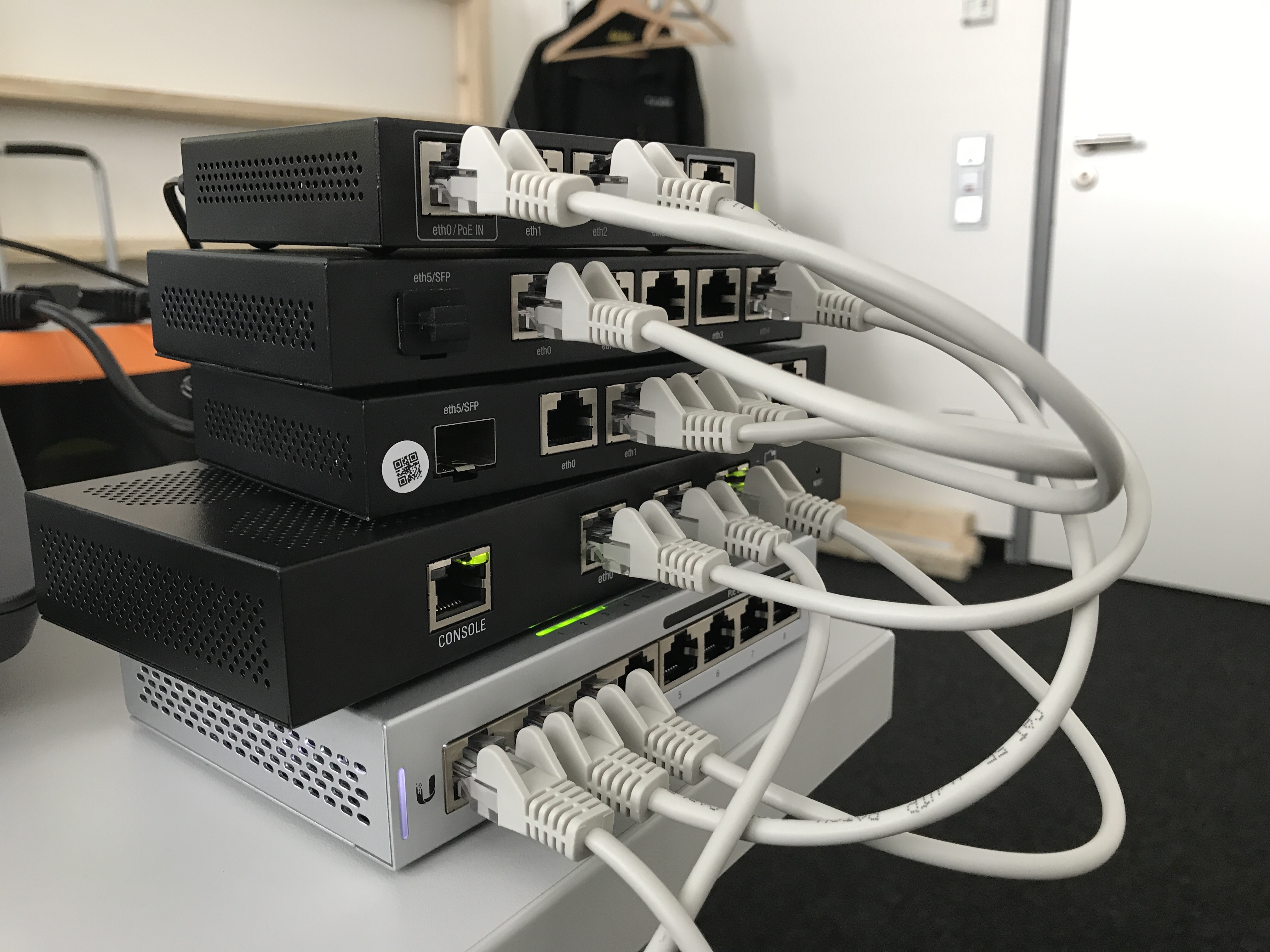
Config ER-R
VPN
configure
set vpn ipsec auto-firewall-nat-exclude enable
set vpn ipsec ike-group FOO0 lifetime 28800
set vpn ipsec ike-group FOO0 proposal 1 dh-group 14
set vpn ipsec ike-group FOO0 proposal 1 encryption aes128
set vpn ipsec ike-group FOO0 proposal 1 hash sha1
set vpn ipsec esp-group FOO0 lifetime 3600
set vpn ipsec esp-group FOO0 pfs enable
set vpn ipsec esp-group FOO0 proposal 1 encryption aes128
set vpn ipsec esp-group FOO0 proposal 1 hash sha1
set vpn ipsec site-to-site peer 203.0.113.1 authentication mode pre-shared-secret
set vpn ipsec site-to-site peer 203.0.113.1 authentication pre-shared-secret 1234
set vpn ipsec site-to-site peer 203.0.113.1 description ipsec
set vpn ipsec site-to-site peer 203.0.113.1 local-address 192.0.2.1
set vpn ipsec site-to-site peer 203.0.113.1 ike-group FOO0
set vpn ipsec site-to-site peer 203.0.113.1 vti bind vti0
set vpn ipsec site-to-site peer 203.0.113.1 vti esp-group FOO0
set interfaces vti vti0 address 10.255.12.2/30
set protocols static interface-route 192.168.1.0/24 next-hop-interface vti0
commit ; save

OSPF
configure
set interfaces vti vti0 ip ospf network point-to-point
set protocols ospf parameters router-id 172.16.1.1
set protocols ospf area 0.0.0.0 network 10.255.12.0/30
set protocols ospf area 0.0.0.0 network 172.16.1.0/24
commit ; save

Config ER-L
VPN
configure
set vpn ipsec auto-firewall-nat-exclude enable
set vpn ipsec ike-group FOO0 lifetime 28800
set vpn ipsec ike-group FOO0 proposal 1 dh-group 14
set vpn ipsec ike-group FOO0 proposal 1 encryption aes128
set vpn ipsec ike-group FOO0 proposal 1 hash sha1
set vpn ipsec esp-group FOO0 lifetime 3600
set vpn ipsec esp-group FOO0 pfs enable
set vpn ipsec esp-group FOO0 proposal 1 encryption aes128
set vpn ipsec esp-group FOO0 proposal 1 hash sha1
set vpn ipsec site-to-site peer 192.0.2.1 authentication mode pre-shared-secret
set vpn ipsec site-to-site peer 192.0.2.1 authentication pre-shared-secret 1234
set vpn ipsec site-to-site peer 192.0.2.1 description ipsec
set vpn ipsec site-to-site peer 192.0.2.1 local-address 203.0.113.1
set vpn ipsec site-to-site peer 192.0.2.1 ike-group FOO0
set vpn ipsec site-to-site peer 192.0.2.1 vti bind vti0
set vpn ipsec site-to-site peer 192.0.2.1 vti esp-group FOO0
set interfaces vti vti0 address 10.255.12.1/30
set protocols static interface-route 172.16.1.0/24 next-hop-interface vti0
commit ; save

OSPF
configure
set interfaces vti vti0 ip ospf network point-to-point
set protocols ospf parameters router-id 192.168.1.1
set protocols ospf area 0.0.0.0 network 10.255.12.0/30
set protocols ospf area 0.0.0.0 network 192.168.1.0/24
commit ; save

Config „Internetwolke“

Schlussendlich hat wer 1:1 Aufbau auch funktioniert und die Performance mit Offloading ware auch ok.
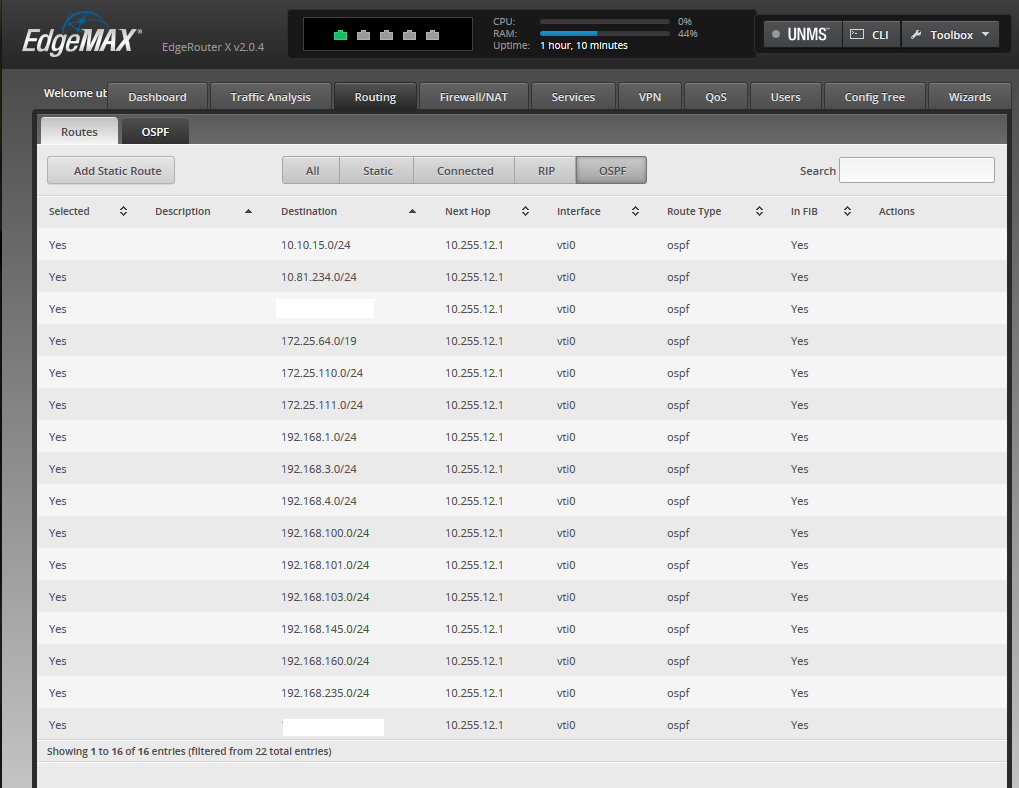
Aber trozudem ließ es sich nicht in Prodution so umsetzen, da warum auch immer, IPSec bei mir zuhause einfach nicht will.
Daher habe ich mir dann kurzerhand die Anleitung geschnappt und das einfach nochmal mit OpenVPN ausprobiert.
Ergebnis… geht, nicht schnell, aber geht und zwar Stabil und mit nur einem Public Port.
Falls jemand Ahnung hat, wie ich Tinc 1.1 auf den EdgeRouter bekomme, bitte gerne.
https://twitter.com/nerdheimeu/status/1149346879332913152

Review: Ubiquiti LiteBeam AC Gen2

So ich habe mir wieder was neues zum Rumspielen besorgt, dieses mal was mir WLAN.
Ich wollte mal testen ob hardware aus dem Preissegment 130€ pro Set mittelerweile besser ist, als die alte Richfunkhardware & geboostete 2,4GHz Hardware mit der ich länglich soaß hatte die erst einmal ans laufen zu bekommen und dann immer wieder Abbrüche & Performanceprobleme hatte
Ziel ware es eine stabile & symetrische Verbindung zu bekommen, die mindestens 100MBit/s bei 20MHz Kanalbreite bietet.
Resultat waren 300+quitsch MBit/s über eine Entfernung von ca. 3,5km und 30MB/s über diese Entfernung, jeweis unterm Ziegekdach installiert finde ich vollkommen angemessen.

Die Bilder des Aufbaus sind bei den ersten Freilufttests entstanden & die Screenshots der Messungen stammen von der finalen Installation.
Das Setup nutze ich übrigens zur Gebäudevernetzung (Storage & Backuptransport) und der Bündelung mehrere Internetanschlüsse.

Weiterlesen